
Pricing pages only show today's number, so it's hard to tell what moved this year and whether it touches your bill. We went through the changelogs of five deploy and build vendors and kept only changes with a vendor source and an effective date.
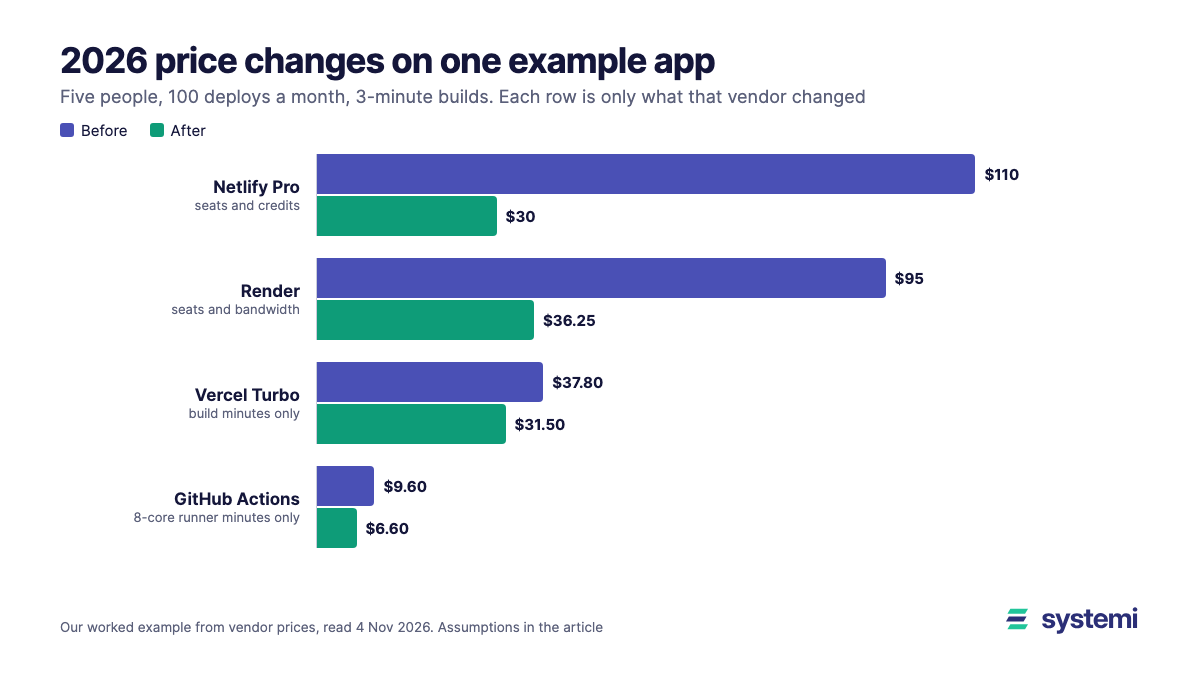
Short version: the 2026 changes mostly cut seat fees and build prices and charged more for traffic. For a five-person team on our example app, Netlify went from $110 to $30 and Render from $95 to $36.25. A solo developer gets no seat saving: Render went up $6 before any bandwidth, and Netlify's credit use rose 38% on our example.
The dated table
| Effective | Vendor | What changed | Source |
|---|---|---|---|
| 1 Jan 2026 | GitHub Actions | Hosted runners cut by up to 39%. Linux 2-core $0.008 to $0.006 a minute, Linux 8-core $0.032 to $0.022, macOS $0.080 to $0.062. Free quotas unchanged | Changelog, rate table |
| 22 Jan 2026 | GitHub Actions | 1 vCPU Linux runner generally available at $0.002 a minute. 5 GB of memory, jobs stop at 15 minutes, and GitHub says it's for automation rather than heavy builds | Changelog, rates |
| 6 Feb 2026 | Heroku | Moved to sustaining engineering. No pricing change for card customers. Enterprise Account contracts no longer offered to new customers | Heroku |
| 14 Apr 2026 | Netlify | Credit Pro went from $20 per seat to $20 with unlimited seats. Bandwidth 10 to 20 credits per GB, compute 5 to 10 credits per GB-hour, web requests 3 to 2 credits per 10,000. Form submissions free. Legacy plans not affected | Changelog, post |
| 23 Apr 2026, all by 1 Aug | Render | Pro $25 flat replaced Professional at $19 per member. Scale $499 flat replaced Organization at $29 per member. Less bandwidth in Hobby and Pro, overage per GB at $0.15 rather than in 100 GB blocks. Extra domains $0.25 a month. Compute prices unchanged | Changelog, post |
| From 27 Apr 2026 | Vercel | Builds priced at $0.0035 per CPU minute. Turbo (30 CPUs) $0.126 to $0.105 a minute. Enhanced $0.028 and Standard $0.014 unchanged | Changelog |
| 1 Oct 2026 | Render | Key Value plans of 1 GB and up cheaper, two plans added. The post gives no figures | Changelog |
One change that didn't happen: GitHub announced a $0.002 a minute charge on self-hosted runners from 1 March 2026, then postponed it with no new date. On 4 November its billing docs still list self-hosted runners as free.
What it does to one example app
Our example: 5 people, 100 production deploys a month, each a 3-minute build, 100 GB of bandwidth, 50 GB-hours of compute and 1 million web requests. Each row counts only the lines that vendor changed, so the rows aren't a comparison of total hosting bills.
| Vendor and lines | Before | After | Working |
|---|---|---|---|
| Netlify Pro, 5 seats | $110 | $30 | Credits 3,050 before, 4,200 after, against 3,000 in the plan. One $10 pack of 1,500 either way, plus 5 seats at $20 before and the $20 plan after |
| Render, 5 members | $95 | $36.25 | 5 at $19 before. After: $25, plus 75 GB beyond the 25 GB in Pro at $0.15. The 300 build minutes fit inside the 1,000 included |
| Vercel, Turbo builds | $37.80 | $31.50 | 300 minutes at $0.126, then $0.105. On Standard or Enhanced, no change: $4.20 or $8.40 |
| GitHub Actions, Linux 8-core | $9.60 | $6.60 | 300 minutes at $0.032, then $0.022 |
| GitHub Actions, Linux 2-core | $2.40 | $1.80 | 300 minutes at $0.008, then $0.006, before the plan's included usage, which covers this much |
Two of those rest on something the vendors' posts don't state. We read Netlify's old Pro plan as 3,000 credits for the whole team, whatever the seat count. For Render we took 100 GB as inside the old plan's bandwidth, because the changelog says the old plans included more without giving the figure in the posts we read.
Who came out behind
Seat removal is why the two big rows fall, so it's worth redoing them for one person. Netlify's solo bill on the same traffic stays at $30, since 3,050 and 4,200 credits both need one pack, but 1,150 more of the 1,500 in that pack are now used up. Render's solo plan goes from $19 to $25 and then adds the same $11.25 of bandwidth.
Traffic is the other side. On Netlify, 300 GB of bandwidth a month was 3,000 credits and is now 6,000, which at the pack rate is about $20 more. Render says a small number of customers with very few seats, high bandwidth or many custom domains may pay more, and that 75% will pay the same or less.
So this year's pattern reads as: people got free, traffic didn't. That's our reading of seven dated changes, and the vendors don't describe it that way. If your team is small and your site is busy, check your bandwidth line before you count on a saving.
What to check on your own account
Netlify's rate changes apply only to credit plans, so a legacy plan keeps its old terms until you switch, and switching means weighing them against the table above. On Vercel, Standard machines are billed only with on-demand concurrency or Elastic machines selected, so find out which machine your builds use before multiplying anything. On GitHub, the cut applies to private repositories, since standard runners on public repositories were already free.
What this table doesn't cover
It covers five vendors and only changes we could date from their own pages, so it isn't a complete list of 2026 price moves. We left Railway out because we found no dated change, and we left out a few Vercel items that either started in 2025 or had no vendor entry with a date. Prices were read on 4 November 2026 and exclude tax. The bills are worked from list prices for an app we made up, and none of them is a real invoice.
Related: Heroku nine months into sustaining engineering covers that vendor's changelog in detail, and what a deploy costs in build minutes turns these rates into monthly figures.
On systemi you send a zip or an https git URL and a branch, and we build and start the app in its own container.
See how deploys work