
On 6 February 2026 Heroku said it was moving to a "sustaining engineering model". The phrase set off a wave of migration guides, many of them guessing at a shutdown Heroku has never announced. Nine months on there is a better source than the guesses: Heroku's own changelog, which logs platform changes with a date. We read it back to December 2024 and counted.
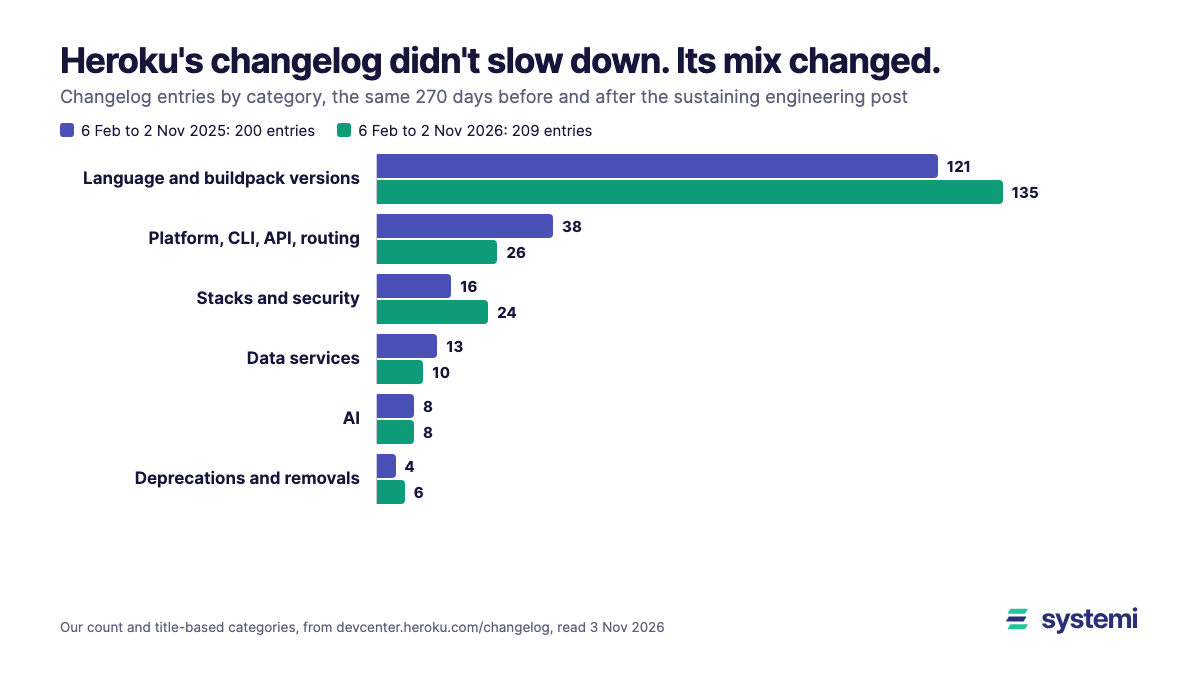
Short version: the number of entries did not fall (200 in the 270 days from 6 February 2025, 209 in the same dates of 2026). The mix moved towards upkeep: platform, CLI and API entries fell from 38 to 26, while language versions and stack updates grew. git push works as before. The things that can stop a build are dated, and three of them fall in the next three months.
What Heroku actually said
The post, by Nitin T Bhat and dated 6 February 2026, makes these claims:
| Claim in the post | Who it affects |
|---|---|
| "Sustaining engineering model focused on stability, security, reliability, and support", with an emphasis on maintaining quality "rather than introducing new features" | Everyone |
| Customers paying by credit card in the dashboard, "both existing and new", continue with no change to pricing, billing, service or daily use | Pay-as-you-go: still on sale |
| Applications, pipelines, teams and add-ons are unaffected | Everyone |
| Enterprise Account contracts are no longer offered to new customers; existing ones are honoured and may renew | Enterprise |
| Investment goes to areas including enterprise-grade AI | Context for the change |
The post gives no end date. Note the wording on features: an emphasis on maintaining rather than introducing, not a statement that nothing new will ship.
What the changelog shows
We pulled the 13 newest pages of the Dev Center changelog on 3 November 2026: 520 entries from 9 December 2024 to 2 November 2026. To compare like with like, we took 6 February to 2 November in each year, 270 days each. The categories are ours, assigned from each title by a script, so treat a difference of one or two as noise.
| Category | 6 Feb to 2 Nov 2025 | 6 Feb to 2 Nov 2026 | Change |
|---|---|---|---|
| Language and buildpack versions | 121 | 135 | +14 |
| Platform, CLI, API, routing | 38 | 26 | -12 |
| Stacks and security | 16 | 24 | +8 |
| Data services | 13 | 10 | -3 |
| AI | 8 | 8 | +0 |
| Deprecations and removals | 4 | 6 | +2 |
| All entries | 200 | 209 | +9 |
Monthly counts stayed in a narrow band: 18 to 27 a month from February to September 2026. October 2026 was the outlier at 42, mostly language releases: 15 of the 17 entries dated 21 to 26 October. A busy month of version bumps is what upkeep looks like, and it's useful upkeep: buildpacks are the part of Heroku a git push app touches on every deploy, and they are still getting new versions. Python 3.15 arrived on 9 October 2026.
Sustaining engineering also hasn't meant nothing new. These all shipped after the post:
| Date | Entry | Matters to a git-push app? |
|---|---|---|
| 4 Mar 2026 | [Default slug limit raised from 500 MB to 1000 MB](https://devcenter.heroku.com/changelog-items/3612), [build timeouts raised](https://devcenter.heroku.com/changelog-items/3613) | Yes: fewer failed pushes for big apps |
| 20 May 2026 | [Heroku-26 stack](https://devcenter.heroku.com/changelog-items/3703) generally available, supported to end of April 2031 (Heroku-24 stays the default) | Yes: a stack with five years of support |
| 30 Jun 2026 | [GitHub Enterprise Cloud integration](https://devcenter.heroku.com/changelog-items/3728) with GitHub Apps | Enterprise customers only |
| 4 Aug 2026 | [Postgres 18](https://devcenter.heroku.com/changelog-items/3751) generally available and the default for new databases | If you use Heroku Postgres |
| 20 Aug 2026 | [Per-app permissions for all Teams](https://devcenter.heroku.com/changelog-items/3749) (View, Deploy, Operate, Manage), previously Enterprise only | Yes, for teams |
| 24 Aug 2026 | [TLS 1.3 and HTTP/2 on *.herokuapp.com](https://devcenter.heroku.com/changelog-items/3796), older TLS ciphers dropped | Yes: clients stuck on those ciphers stop connecting |
| 6 Oct 2026 | [Heroku Postgres Advanced](https://devcenter.heroku.com/changelog-items/3802) generally available: decoupled compute and storage, follower pools, logical replication | If you outgrow the current tiers |
What got less comfortable
Two quieter entries change what you can rely on. Ten days after the post, Heroku changed its API compatibility policy: the old rule said disruptive changes to Production API resources may not occur without a new major version; the new one allows them with three months' notice in the changelog. If you have scripts on the Platform API, the changelog is now something to watch. And since 13 April 2026 Heroku destroys build and CI logs older than one year, so export them if an audit needs them.
The newer platform generation is the other thing to read carefully. Fir, generally available since April 2025, runs in Private Spaces. Heroku's generations page, last updated 11 September 2026, lists Common Runtime on Fir as "To Be Added", along with dyno autoscaling and Heroku CI. So an app on Eco, Basic or Standard dynos stays on Cedar for now. Whether that row ever gets ticked is the question to keep an eye on.
What a git-push app should check now
These dates are from Heroku's own entries. Each one stops builds or forces an upgrade, and none of them is a sign of a wind-down: they are the normal version policy, still running.
| Date | What happens | Check |
|---|---|---|
| 11 Nov 2026 | [No new Postgres 15 databases](https://devcenter.heroku.com/changelog-items/3750) | `heroku pg:info` |
| 6 Jan 2027 | [Python 3.10 removed from the buildpack](https://devcenter.heroku.com/changelog-items/3856): existing apps run, new builds need an upgrade | `heroku run python --version` |
| 28 Jan 2027 | Forced upgrades of Postgres 15 databases begin; end of life 28 Feb 2027 | `heroku pg:info` |
| 30 Apr / 1 May 2027 | [Heroku-22 reaches end of life](https://devcenter.heroku.com/changelog-items/3705), then builds are refused; apps keep running without security updates | `heroku stack` |
| 5 Jan 2028 | [Python 3.11 removed from the buildpack](https://devcenter.heroku.com/changelog-items/3857) | `heroku run python --version` |
The bill is the other number to keep in view. The pricing page on 3 November 2026 lists Eco at $5, Basic at $7, Standard-1X at $25 and Standard-2X at $50 a month, with Essential-0 Postgres at $5. Basic plus Essential-0 comes to $12 a month, or $144 a year. At that size, a rushed migration costs more in working days than a year of hosting, so the case for moving has to come from something other than the bill.
Facts, and our reading of them
Everything above is sourced. From here on it's our opinion.
| Evidence | Reads as |
|---|---|
| Pay-as-you-go still sold, no end date given, Heroku-26 supported to 2031 | No sign of a near wind-down |
| Language, stack and security entries up from 137 to 159 | Upkeep is being done |
| Platform, CLI and API entries down from 38 to 26 | Slower platform work, as the post said |
| Fir still lists Common Runtime as to be added, 18 months after going GA | Small apps may stay on Cedar for a long time |
| New Enterprise contracts stopped; three months' notice for breaking API changes | Less long-term commitment than before |
Our reading: if your app runs fine on Heroku, nothing here forces a move this quarter. What we would do is keep the app able to leave. Keep it building from a plain Dockerfile or a standard buildpack, keep the data in a database you can pg_dump, avoid building new work on Heroku-only add-ons, and subscribe to the changelog feed. A migration you have rehearsed costs little to postpone. Any forecast of when Heroku ends is a guess, including ours.
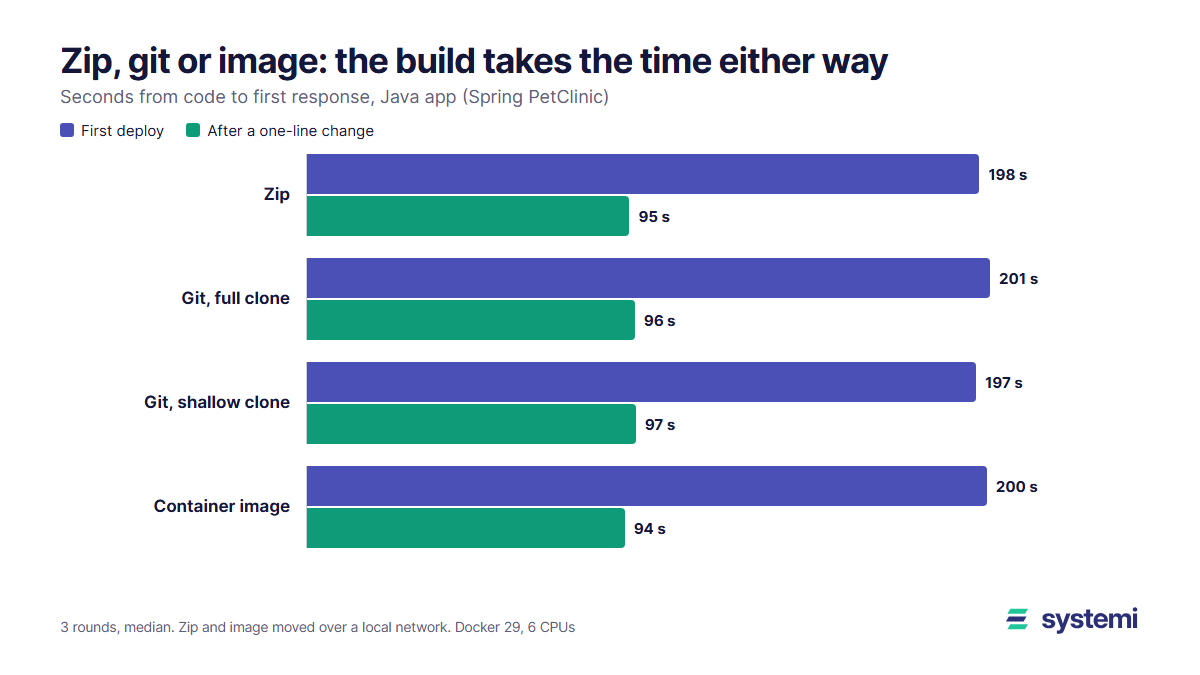
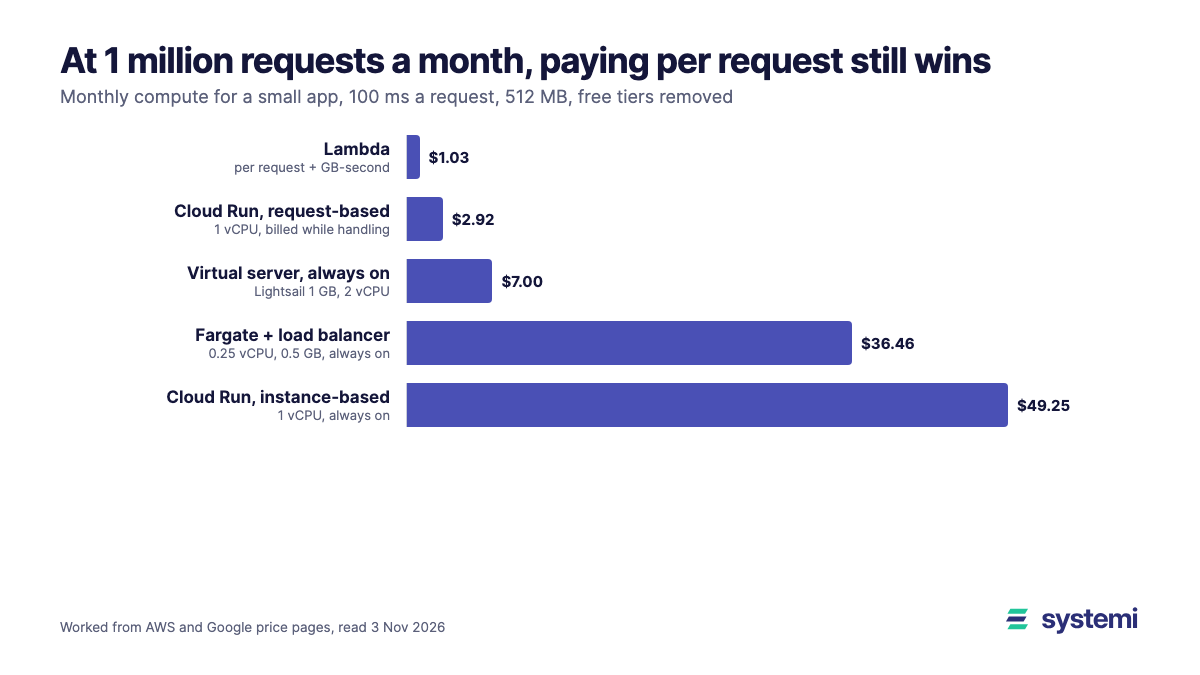
If you do try another host, the deploy path is the first thing to compare. We timed the three common ones in zip, git URL or container image. And if your bill is mostly idle time, see what scale to zero costs from 10 thousand to 10 million requests.
Sources (all read 3 Nov 2026): An Update on Heroku, Heroku blog, 6 Feb 2026; Dev Center changelog and the entries linked above; Heroku Generations, updated 11 Sep 2026; Heroku pricing. The entry counts and categories are our own.
On systemi you deploy a Python, Java, .NET, PHP or static app from a zip or an https git URL and a branch, and we build and run the container, with a PostgreSQL database per app.
See how deploys work