
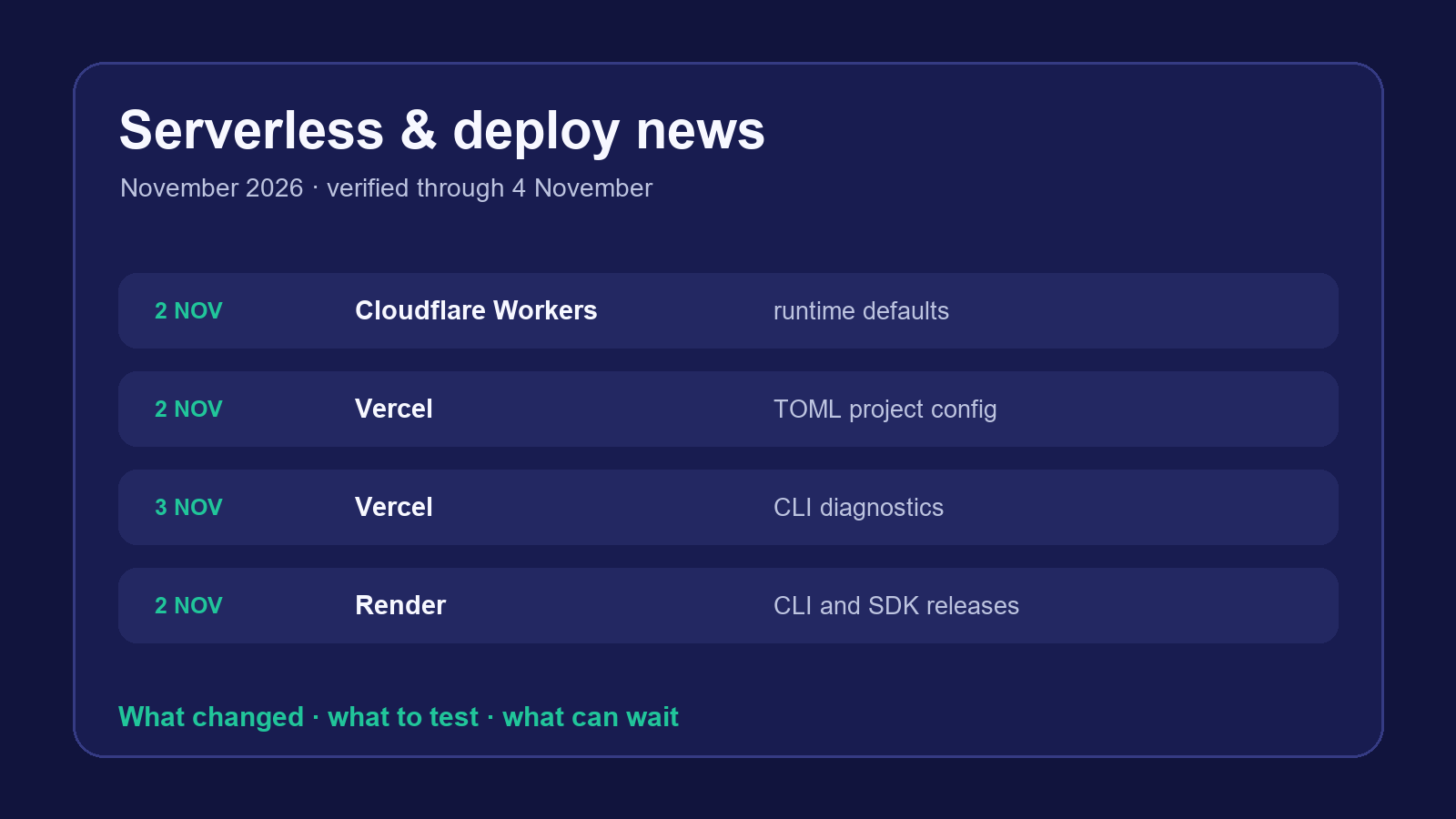
This roundup includes only vendor posts dated 1–4 November 2026 and only changes that affect how an app is configured, deployed, diagnosed or run. That leaves five useful items: two upcoming Workers defaults, a second project-config format and a diagnostic command at Vercel, and coordinated Render client releases.
The short list
| Date | Vendor change | Action |
|---|---|---|
| 2 Nov | Cloudflare: new JavaScript module registry becomes default for compatibility dates from 17 Nov | Test imports, require() and top-level await before advancing the date |
| 2 Nov | Cloudflare: request.signal disconnection events become default from the same date | Check cancellation handling and outgoing requests |
| 2 Nov | Vercel: vercel.toml can replace vercel.json or vercel.ts | No migration needed; use one config file only |
| 3 Nov | Vercel CLI adds vercel doctor and JSON output | Add a non-interactive preflight to deploy diagnostics |
| 2 Nov | Render: CLI 2.35.0 and Python/TypeScript SDK 1.7.0 released | Pin and test before updating automation |
Cloudflare's date-gated defaults deserve the first test
Cloudflare says JavaScript Workers with compatibility date 2026-11-17 or later use its new module registry by default. It improves standards and Node.js compatibility, including require() loading ES modules, but require() fails when the module or a dependency uses top-level await. Invalid import attributes are rejected. Python Workers remain on the legacy registry.
The same compatibility date enables client-disconnection events through request.signal. That lets a Worker cancel downstream work after the caller leaves. It also means existing abort listeners start receiving a signal they did not receive by default before.
Our reading: these are worthwhile defaults, but a compatibility date is code. Exercise startup imports, one cancelled request and one downstream fetch in a preview environment. Do not advance the date only to make a dashboard warning disappear.
Vercel adds a config choice and a deploy preflight
Vercel's 2 November post says vercel.toml supports the same properties as vercel.json, with comments and a flatter structure. A project must use only one of vercel.toml, vercel.json or vercel.ts. Existing projects gain nothing by converting unless comments or TOML fit the repository better.
On 3 November, Vercel added vercel doctor. It checks the CLI install and version, login and team, project link, project configuration, and current platform incidents. It does not prompt, log in or link a project, and --json returns statuses and suggested commands. That makes it useful evidence in CI or a bug report without letting a diagnostic mutate the project.
Render's update is tooling, not a platform migration
Render's changelog lists CLI v2.35.0 and Python and TypeScript SDK v1.7.0 on 2 November. The changelog gives release links but no platform behavior change. Treat this as a dependency update: read the release diff, pin the version in automation, and run a harmless list or validation command before changing a deploy job.
What we excluded
Vercel also posted MCP cards and security-review items during the period. They may be useful, but they do not change the basic git/zip deploy path covered here. We also excluded October announcements and undated documentation even where search results surfaced them. A monthly roundup should not backfill a thin month with older news.
Sources, checked 4 Nov 2026: Cloudflare Workers changelog; Vercel's vercel.toml announcement and vercel doctor announcement; Render changelog. Facts above come from those vendor pages; prioritisation and suggested tests are our analysis.
On systemi you can deploy from a zip or an https git URL and branch without adopting a vendor-specific project file.
Read the deploy guide