
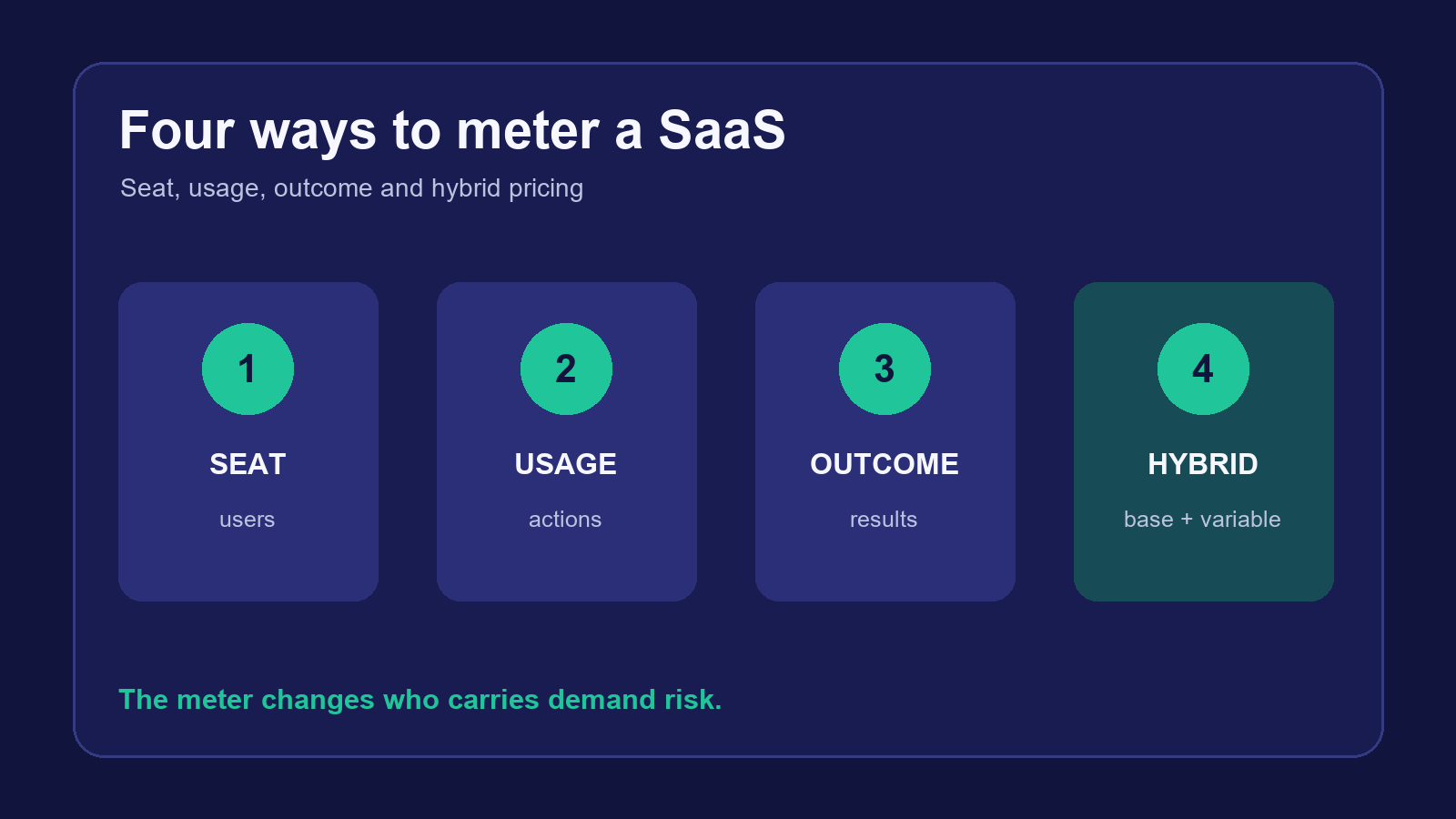
The February 2026 software sell-off revived an old SaaS question: if software does more work with fewer people, should its price still rise with headcount? A market move cannot prove that any one pricing model has won. Vendor price pages do show four distinct meters in use now: seats, usage, outcomes, and a hybrid of fixed seats plus variable work.
This is a worked model, not a recommendation to copy another vendor. We use public prices read on 4 November 2026 and a fictional support team so the arithmetic is inspectable.
The four meters
| Model | Customer pays for | Public example | Cost equation |
|---|---|---|---|
| Seat | People with access | Slack Pro: $7.25 per active user/month annually | active users × $7.25 |
| Usage | Units consumed | Salesforce Flex Credits: $500 per 100,000 credits; a standard action uses 20 credits | actions × 20 × $0.005 |
| Outcome | A defined result | Intercom Fin: $0.99 for a resolution, procedure handoff or disqualification | billable outcomes × $0.99 |
| Hybrid | Access plus variable results | Intercom Essential annual: $29 per full seat/month, plus Fin outcomes | seats × $29 + outcomes × $0.99 |
The examples are deliberately not feature substitutes. They are evidence of how each meter works. Salesforce also publishes $125 per user/month for unmetered employee Agentforce, showing that the same vendor can offer a usage meter and a seat meter for different jobs.
One support team, four illustrative bills
Assume 10 human agents, 5,000 customer conversations a month, and two automatable actions per conversation. At 20 credits per Salesforce action, that is 200,000 credits. If automation completes 40% of conversations, that is 2,000 billable outcomes. We apply each public rate mechanically; this does not compare the products' features.
| Meter | Calculation | Monthly amount |
|---|---|---|
| Seat example | 10 × $7.25 | $72.50 |
| Usage example | 10,000 actions × 20 credits × $0.005 | $1,000.00 |
| Outcome example | 2,000 outcomes × $0.99 | $1,980.00 |
| Hybrid example | 10 × $29 + 2,000 × $0.99 | $2,270.00 |
These totals are useful only as sensitivity tests. The usage example bills every configured action whether or not the conversation ends well. The outcome example bills a result under the vendor's definition. The seat examples do not rise when conversations rise, but they do rise when the team hires.
Where the risk moves
| Change in the customer's month | Seat | Usage | Outcome | Hybrid |
|---|---|---|---|---|
| Conversations double; team stays at 10 | No change | Roughly doubles | Roughly doubles if outcome rate holds | Variable part roughly doubles |
| Team doubles; volume stays flat | Doubles | No change | No change | Seat part doubles |
| Automation becomes more efficient | No direct change | Can fall if fewer actions run | Can rise if more outcomes complete | Outcome part can rise |
| Vendor's definition is disputed | Low metering dispute | Was the action run? | Was the promised result achieved? | Both access and outcome questions |
Outcome pricing is not automatically aligned pricing. The definition matters. Intercom says a resolution can be confirmed by the customer or assumed when the customer leaves without asking for more help; it later reverses the charge if that customer returns to the same conversation for more help. That is more auditable than saying 'value delivered', but a SaaS founder still needs an event ledger, reversals, limits and a dispute path.
A practical model-selection test
| Question | If yes |
|---|---|
| Does one more user create roughly the same cost and value? | A seat can be legible. |
| Can customers predict and control the unit? | Usage can work; expose a meter and hard limit. |
| Can both sides verify success from durable events? | An outcome meter is possible; define reversals before launch. |
| Do customers need a stable platform plus bursty automation? | A hybrid can fund the base product while tracking variable work. |
For a new SaaS, the safest first spreadsheet has three columns for every meter: the customer's expected bill, the 90th-percentile bill, and your cost at both levels. Then test the awkward cases: a bot loop that runs 100 actions, a result reversed next month, a contractor needing one-day access, and a customer whose volume doubles before their budget does.
Sources (read 4 Nov 2026): Slack Pro pricing; Salesforce Agentforce pricing and Flex Credit examples; Intercom pricing, pricing FAQ dated 27 Aug 2026, and Fin outcome definitions dated 23 Sep 2026. Calculations and interpretation are ours.
When the product model is settled, systemi lets you deploy a SaaS from a zip or an https git URL and branch.
See the deploy guide